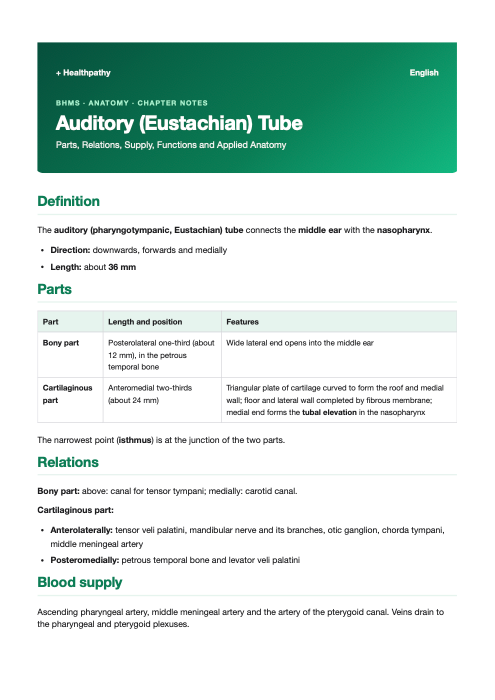
The auditory (Eustachian) tube keeps the pressure equal on both sides of the eardrum. It is a common short note and links anatomy with ENT problems such as ear block during flights.
Quick facts
About 36 mm long, from the middle ear to the nasopharynx.
One-third bony, two-thirds cartilaginous.
Opens during swallowing and yawning.
What you need to learn
Direction and length
Bony and cartilaginous parts
Relations
Blood, nerve and lymphatic supply
Functions
Applied anatomy
Common mistakes
Writing “retroperitoneal” nodes; the tube drains to retropharyngeal nodes.
Listing hoarseness under Eustachian catarrh; the symptoms are a blocked ear, deafness and tinnitus.
Get the complete notes
The Auditory Tube PDF gives both parts, their relations and the functions in a clean exam format.
Tensor veli palatini, helped by salpingopharyngeus, during swallowing and yawning.
Medical disclaimer: This article is for general information and education only. It is not a substitute for professional medical advice, diagnosis or treatment. Always consult a qualified doctor about your health.