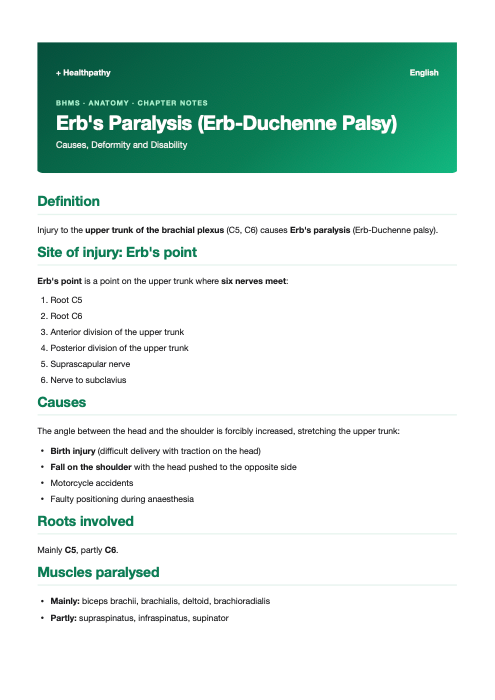
Erb’s paralysis (Erb-Duchenne palsy) is an injury of the upper part of the brachial plexus, often seen after a difficult birth. It is one of the most frequently asked 5-mark short notes in upper limb anatomy, and the “waiter’s tip” deformity is a favourite viva question.
Quick facts
Injury to the upper trunk (mainly C5) at Erb’s point.
The arm takes the waiter’s tip position.
Common cause: birth injury with traction on the head.
What to write in the exam
Definition and site (Erb’s point and the six nerves meeting there)
Causes
Roots involved
Muscles paralysed
Deformity, with the reason for each position
Disability: movements and reflexes lost
Common mistakes
Listing “Saturday night palsy” as a cause (that is a radial nerve injury).
Writing that adduction is lost; the movements lost are abduction and lateral rotation of the arm.
Get the complete notes
The Erb’s Paralysis PDF gives the full short note in the order examiners expect, with a table explaining each part of the deformity. Compare it with Klumpke’s paralysis in the Upper Limb Notes bundle.
Mainly C5 and partly C6, at the upper trunk of the brachial plexus.
What is the deformity in Erb's paralysis called?
The waiter's tip (policeman's tip) position.
Medical disclaimer: This article is for general information and education only. It is not a substitute for professional medical advice, diagnosis or treatment. Always consult a qualified doctor about your health.